
SEO · BUSINESS BUILDING · STRATEGY

CASE STUDY

Tech Investeor News

The Client

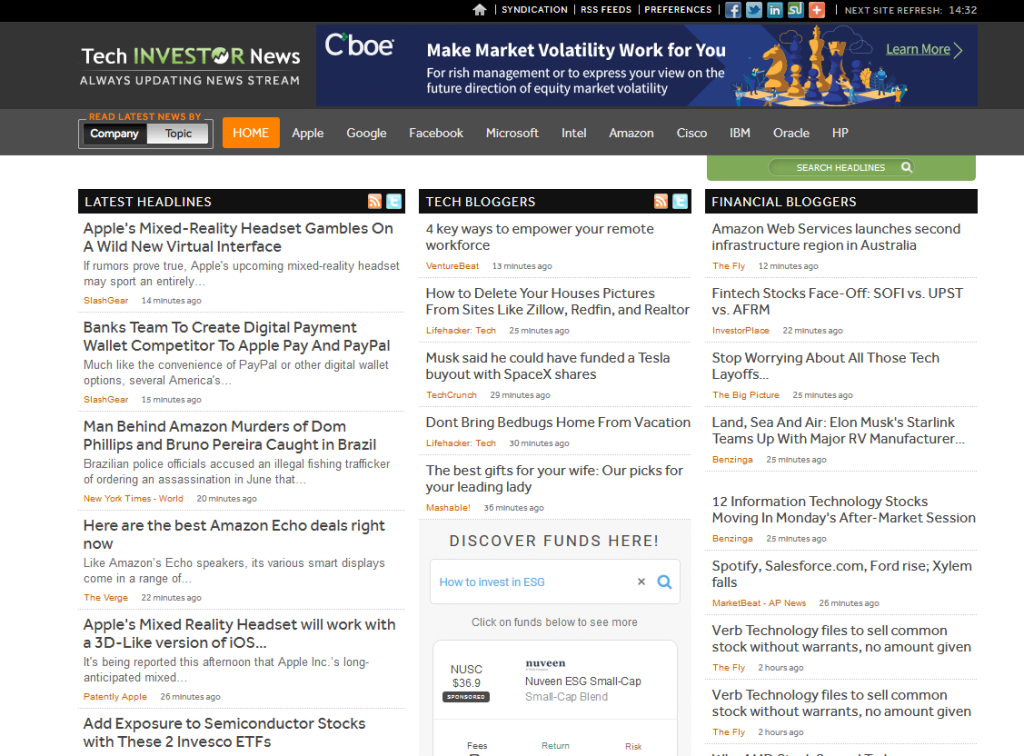
A financial news aggregator site — text-only, no original content, monetized through AdSense. The owner had built an algorithmic system that filtered RSS feeds from major financial news sources and organized them by topic. Clean, functional, but invisible.

The Problem

When he contacted me in 2012, the site was getting about 135 daily visitors.

He knew it could do better but had a critical constraint:

He didn’t want to go back to the original sources to pull more content.

All I had to work with was what came through the RSS feeds: title and synopsis only.

The existing structure:

  • ~20 pages total (one page per menu category)
  • Each page displayed hundreds of content blocks
  • Each block: headline + full synopsis + immediate link offsite
  • 100% bounce rate (every click left the site)
  • No depth, no dwell time, no engagement signals
  • Nothing for Google to index beyond those 20 thin pages

The challenge:

How do you 10x traffic on a site where:

  • You can’t create new content
  • You can’t pull more content from sources
  • Every piece of value (the actual article) lives offsite
  • The entire site is essentially a directory of links

The Strategy

I didn’t optimize the content. I re-architected the information flow.

The insight: We didn’t need MORE content. We needed better STRUCTURE.

Google doesn’t just index words. It indexes:

  • Site depth (how many levels/pages)
  • Dwell time (engagement signals)
  • Freshness (how often pages update)
  • Internal linking patterns
  • Topical organization

We could manipulate ALL of these without adding a single word of content.

Phase 1: Menu Restructuring

Changed menu terms from descriptive labels to keyword-focused categories.

Not “Latest Updates” → “Tech Stock Analysis” Not “Market News” → “Venture Capital Funding”

Every menu item became a landing page optimized for specific search terms.

Phase 2: Content Depth Architecture

Original flow: Landing page block → Headline + full synopsis + offsite link → GONE

New flow: Landing page → Headline + first few words → Internal page → Full synopsis + offsite link

This created:

  • 2X the indexed pages (every feed item now had its own page)
  • Longer user journey (two clicks instead of one)
  • More dwell time (users reading full synopsis on internal page)
  • More internal links (thousands of landing page → detail page connections)

Phase 3: On-Page SEO Layers

Added topical subgroupings on individual menu pages with keyword-rich H2 tags.

This gave Google:

  • Clear topical hierarchy
  • More keyword signals
  • Better semantic organization

Phase 4: Engagement Signals

The new tab trick: Links to offsite articles opened in NEW tabs, keeping the original site tab open.

Google sees: Longer session duration (the tab stayed open while users read articles elsewhere)

Phase 5: Freshness Signals

Added “More” button after the first X entries on landing pages.

Why this mattered:

Every time someone clicked “More,” it loaded more content dynamically.

To Google’s crawler, the landing page looked like it was constantly updating — fresh content signals without actually creating new content.

Timeline: 1 month to code all the changes.
The Results

48 hours after launch:

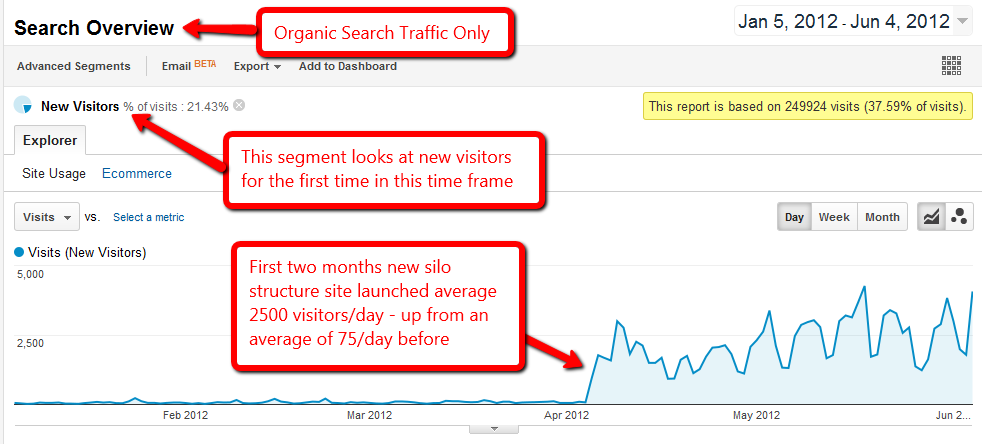
75 daily visitors → 2,500+ daily visitors

3334% TRAFFIC INCREASE.

The longevity:

This wasn’t a spike. It was a new baseline.

tech investor traffic upgrade apr-jun
Google shifted algorithms over the years. Owner would call me. We’d make small adjustments. The site kept performing.

Years of sustained 4,500+ daily visitor traffic — all from a single architectural restructure with ZERO new content creation.


What Made This Work

1. Information Architecture > Content Volume

Everyone thinks SEO success requires:

  • More content
  • Longer articles
  • Original research

This site had NONE of that.

What it had: Perfect information architecture that gave Google exactly what its algorithms rewarded.

2. Systems Thinking: Cascading Advantages

The restructure created multiple compounding benefits:

Before:

  • 20 indexed pages
  • 100% bounce rate
  • Zero dwell time
  • No depth signals
  • Static pages

After:

  • 1,000+ indexed pages (every feed item = new page)
  • Multi-step user journey (landing → detail → offsite)
  • Extended dwell time (tab trick + deeper pages)
  • Clear site hierarchy (menu → category → subgroup → detail)
  • Freshness signals (pagination updates)

Each change reinforced the others. The system compounded.

3. Understanding What Google Actually Rewards

Most SEO focuses on:

  • Keyword density
  • Backlinks
  • Content length

I focused on:

  • Crawlability (more pages to index)
  • Engagement signals (time on site, pages per session)
  • Freshness (dynamic pagination)
  • Topical authority (clear hierarchy)
  • Internal linking (thousands of connections)

Google’s algorithm rewarded site architecture, not just content quality.

4. Constraint-Based Innovation

The owner’s constraint — “don’t pull more content” — forced a better solution.

If I could have added content, I might have just written more articles.

Instead, I had to think architecturally. And that created a more sustainable, scalable system.

5. Speed to Results

1 month of coding → 48 hours to 33x traffic.

This wasn’t “SEO takes 6-12 months to work.”

This was structural leverage creating immediate algorithmic response.


The Lessons

1. Architecture > Volume

You don’t always need more content. Sometimes you need better structure.

33x traffic increase with ZERO new content creation.

2. Understand what the algorithm actually rewards

Google doesn’t just read words. It evaluates:

  • Site depth
  • User behavior
  • Freshness signals
  • Internal linking patterns
  • Topical organization

Optimize for the system, not just the keywords.

3. Cascading advantages compound

Each structural change created multiple benefits:

  • More pages → more entry points → more traffic
  • Deeper structure → longer sessions → better engagement signals
  • Pagination → freshness signals → more frequent indexing
  • H2 subgroupings → topical clarity → better rankings

The whole was greater than the sum of parts.

4. Constraints force better thinking

“You can’t create more content” seemed like a limitation.

It forced architectural innovation that was more powerful than content creation would have been.

5. Good systems endure

This wasn’t a hack that broke when Google updated.

The architectural improvements were aligned with what Google fundamentally valued: good user experience, clear organization, engaged visitors.

Small adjustments over the years kept it working. The foundation was sound.


The Footnote

This was 2012. Google’s algorithms have evolved significantly.

Some tactics (the new tab trick, pagination freshness signals) might work differently now.

But the PRINCIPLES still hold:

  • Site architecture matters as much as content
  • User engagement signals influence rankings
  • Depth and internal linking create crawlability
  • Topical organization improves algorithmic understanding
  • Systems thinking beats tactical optimization

You can’t copy the 2012 playbook in 2026.

But you can apply the same strategic thinking: understand what the algorithm rewards, then architect your information to deliver it.

And when you do, results can happen in hours, not months.


Want Results Like This?

I don’t take on agency clients anymore.

But I teach the strategic thinking that made this (and dozens of other case studies) possible.

AI Profit Engineer - 3d

My Software

AI Profit Engineer
(handles the heavy lifting)

No-Click mockup

My Book

No-Click Content Strategy
(launched Jan 15, 2026)

MDI logo

My Training

Certified Profit Engineer
(opens Mar 17, 2026)