
Written by AI Profit Engineer
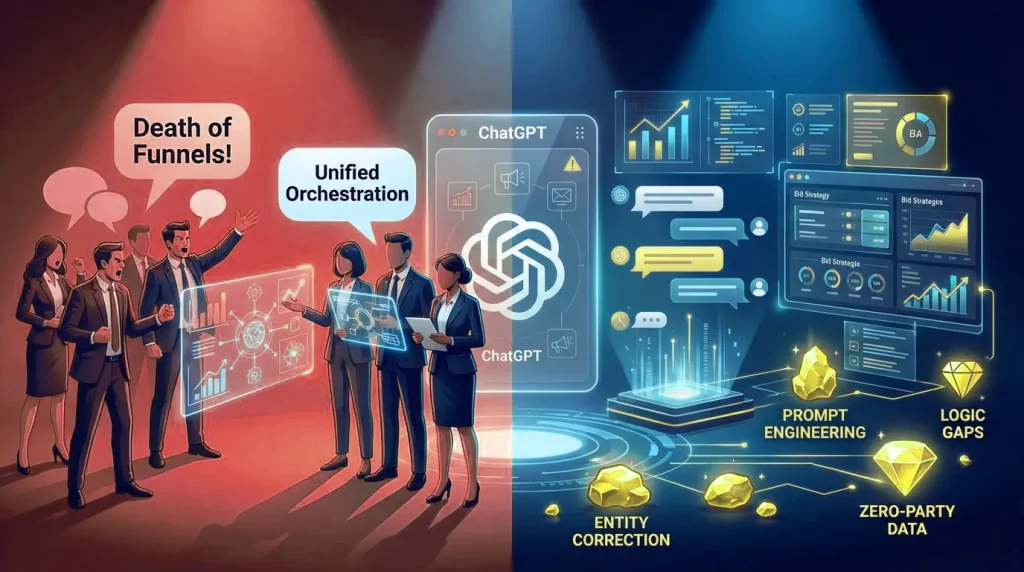
Camp One screams “The Death of Funnels!” They believe conversational AI will collapse the entire customer journey into a single chat thread. No more landing pages. No more email sequences. Just one perfect conversation that ends in a purchase.
Camp Two whispers “Unified Orchestration.” They see ChatGPT ads as another channel to manage alongside Facebook, Google, and LinkedIn. Same playbook, different interface.
Both camps are missing the real opportunity.
While everyone debates whether ChatGPT will kill funnels or just become another ad platform, the actual competitive advantages are hiding in plain sight. The businesses that win in this new landscape won’t be the ones with the loudest opinions about conversational commerce. They’ll be the ones exploiting the unique mechanics that only exist in AI-driven advertising.
Here’s something no one’s talking about: ChatGPT hallucinates about your business.
Right now, if someone asks ChatGPT about your company, there’s a decent chance it will confidently state incorrect information about your pricing, features, or positioning. The AI is working from incomplete or outdated training data, and it fills in gaps with educated guesses that are often wrong.
Most businesses see this as a problem to complain about. Smart businesses see it as an arbitrage opportunity.
Every hallucination is a bidding opportunity. When ChatGPT says your software costs $200/month instead of $99/month, that’s not just misinformation—it’s a sponsored correction waiting to happen.
The strategy is simple: identify every factual error ChatGPT makes about your business, then bid on the prompts that trigger those errors. When someone asks about your pricing and gets the wrong answer, your sponsored response provides the correct information.
You’re not just buying ad space. You’re buying truth correction. And users will trust sponsored corrections more than organic hallucinations because the correction comes with accountability.
Forget bidding on competitor keywords. In conversational AI, you bid on logic gaps.
When someone asks “What’s a cheaper alternative to Salesforce?” they’re not just looking for competitor names. They’re revealing a decision framework: cost is their primary constraint, and they’ve already mentally positioned Salesforce as expensive.
Traditional search advertising would have you bid on “Salesforce alternative” and hope your ad gets clicked. ChatGPT advertising lets you inject a sponsored comparison table directly into the conversation thread.
But here’s the advanced play: instead of just listing your features, you’re bidding on the logical assumptions behind their question. If they want “cheaper,” your sponsored response doesn’t just show your lower price—it reframes the cost conversation entirely.
“Here’s why comparing software by monthly cost actually increases your total expense over 24 months…” followed by a sponsored analysis that positions your higher-priced solution as the economically rational choice.
You’re not competing on their logic. You’re replacing their logic with better logic, and getting paid placement to do it.
The creative unit in ChatGPT advertising isn’t a headline or an image. It’s a conversation catalyst.
Instead of writing ad copy that sells, you’re writing prompts that continue the conversation in directions that favor your solution. Your “creative” might be a pre-formatted follow-up question that appears as a sponsored suggestion.
User asks: “How do I improve my email deliverability?”
Your sponsored prompt injection: “Would you like to see how [Your Platform] handles reputation management for high-volume senders?”
The user doesn’t see this as an ad. They see it as ChatGPT being helpful by suggesting a more specific question. But you’ve just steered the conversation toward your core differentiator.
This is copywriting at the cognitive level. You’re not persuading people to click. You’re persuading them to think in frameworks that make your solution inevitable.
A Google search click tells you someone searched for “project management software.” A ChatGPT conversation tells you their team size, budget constraints, current tools, integration requirements, and timeline for implementation.
The real value of ChatGPT advertising isn’t the immediate conversion. It’s the conversation data.
Every multi-turn chat reveals psychographic and behavioral information that would take traditional marketers months of nurture sequences to uncover. Someone asking follow-up questions about security features, pricing flexibility, and mobile access is painting a detailed picture of their decision-making process in real-time.
Smart advertisers are using ChatGPT ads not to drive immediate sales, but to drive conversations that their CRM systems can parse for intelligence. The ad spend pays for itself through data collection, even if the immediate conversion rates are lower than traditional channels.
You’re not buying clicks. You’re buying psychological profiles.
Here’s the uncomfortable truth about conversational interfaces: screen real estate is brutally limited.
On mobile, a sponsored response block might occupy 50% of the visible conversation area. Unlike Google, where users can scroll past ads to see organic results, ChatGPT presents information sequentially. If your competitor’s sponsored response appears first, it shapes the entire conversation that follows.
This creates a new category of defensive advertising: space filling.
You’re not bidding to convert. You’re bidding to prevent competitors from occupying the only visible alternative to ChatGPT’s organic response. It’s digital real estate acquisition disguised as advertising.
The businesses that understand this early are building “conversation moats” around their key topics. They’re not just advertising their solutions—they’re advertising their frameworks for thinking about problems. When someone asks about your industry, your sponsored content doesn’t just mention your product. It establishes the mental models that make your approach seem obviously correct.
While everyone argues about whether ChatGPT will revolutionize advertising, the revolution is already happening in the details.
The businesses winning in this new landscape aren’t the ones with the biggest ChatGPT advertising budgets. They’re the ones who recognized that conversational AI creates entirely new forms of competitive advantage that have nothing to do with traditional advertising metrics.
They’re correcting AI hallucinations about their business. They’re bidding on logical frameworks instead of keywords. They’re using prompt engineering to steer conversations. They’re harvesting zero-party data at scale. They’re buying defensive conversation space.
The hype will settle. The camps will pick sides. The real opportunities will go to the businesses that stopped debating the future of funnels and started exploiting the mechanics of conversational commerce.
The question isn’t whether ChatGPT ads will change everything. The question is whether you’re positioned to profit from the changes that are already happening.