
TLDR:
These seven macrotrends I taught fifteen years ago are still valid. What’s changed is the speed. The timelines under them have compressed so violently this year that owners who DO NOT reposition by Q4 will lose the categories they think they own.
AI is the engine driving the compression.
Below: two reframes, one sixty-day case study, and the work you should seriously do this week.
In 2011 I drew this for my certification students.
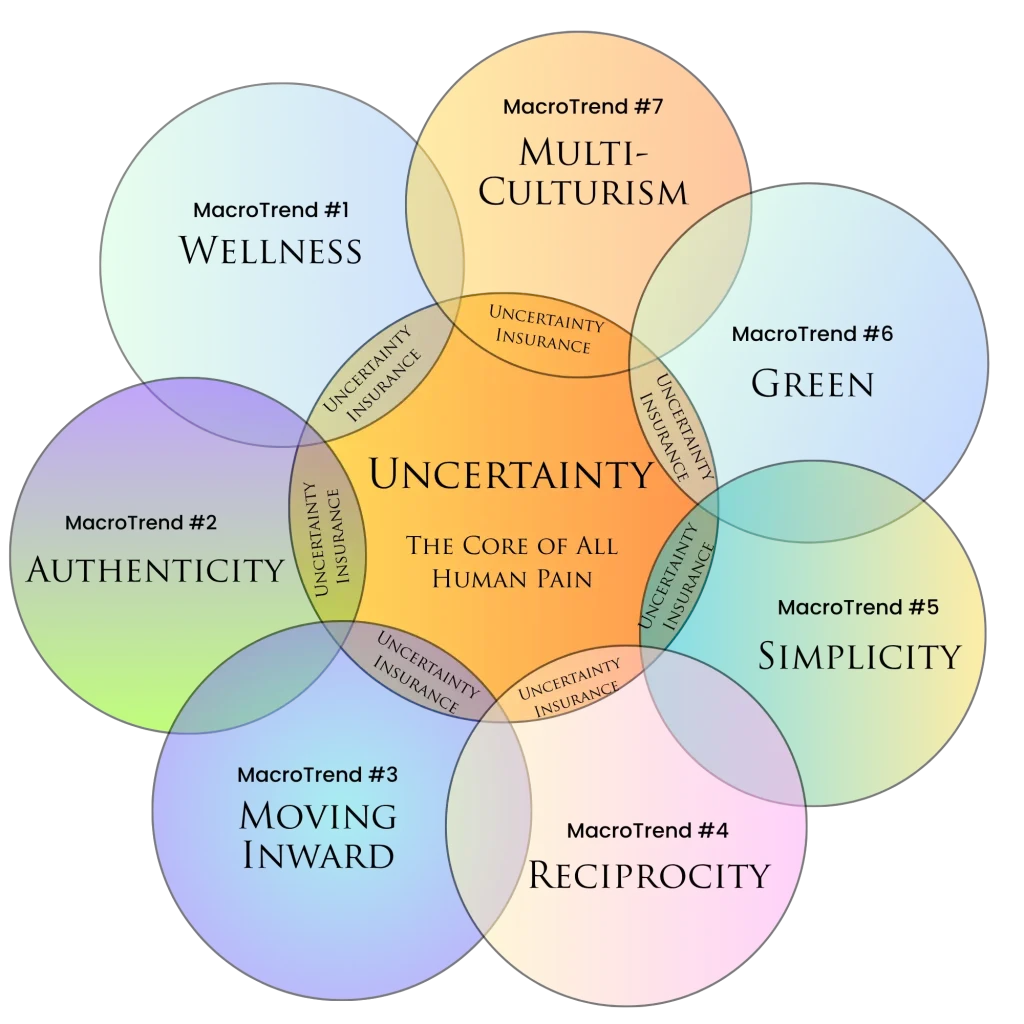
Uncertainty in the middle – it butts up against everything because as humans, we are never sure of what the f* it is we’re doing. Seven macrotrends in orbit. The lesson, summed up in one sentence: every macrotrend is an inroad to an audience, and the place where uncertainty intersects a trend is a pain point waiting for a product.
Build into the intersection and your product carries its own gravity. Ignore it and your marketing has to work a LOT harder.
Fifteen years later, the diagram still holds. What changed is what’s in the middle.
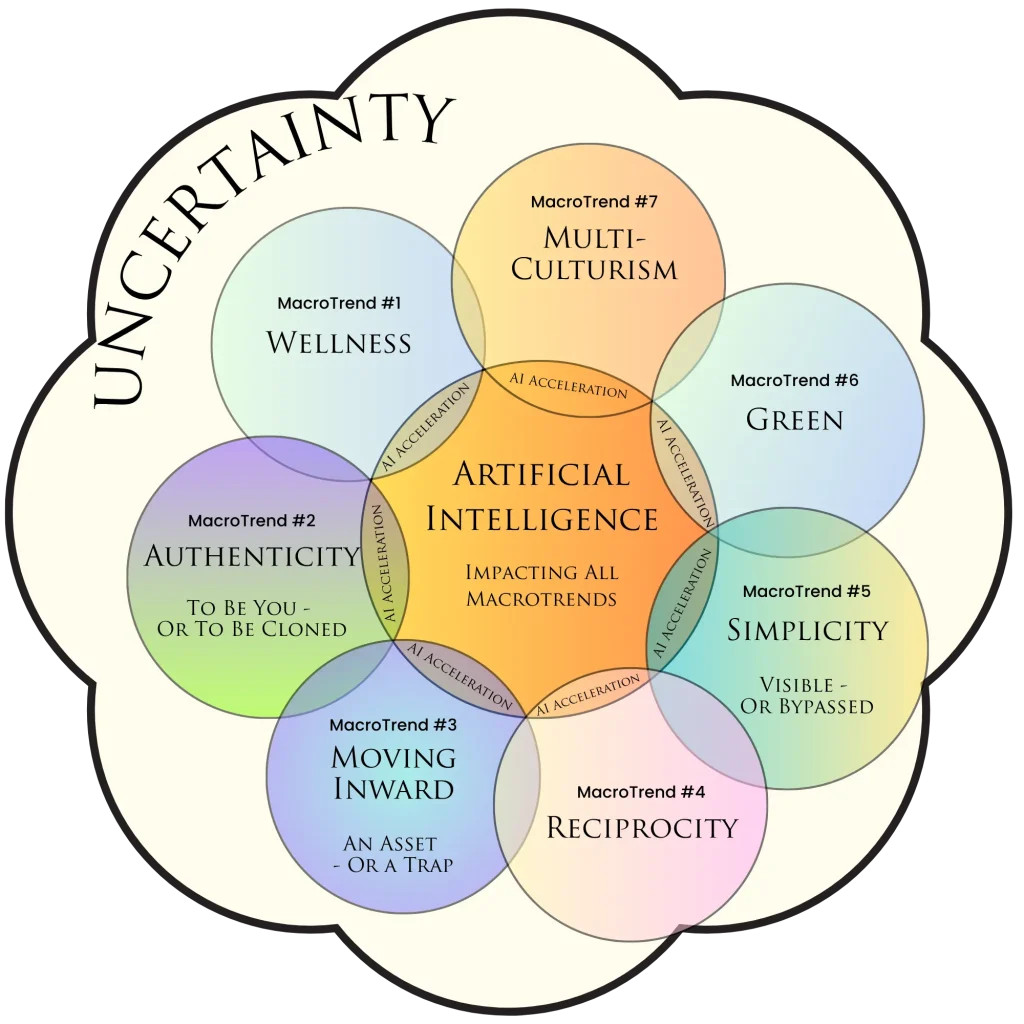
Same seven trends. New engine. New climate. All seven are still valid. We’ll work through two as reframes today — Authenticity and Moving Inward. The third, Simplicity is in motion RIGHT NOW. I’m showing you the evidence, because you need to see it and understand it’s real and it’s here TODAY.
You’ll see the last sixty days when agentic commerce rebuilt itself under your feet. By the time we’re done, you’ll have what you need to extrapolate the rest.
Before we go there, open Claude or ChatGPT in another tab. The most useful hour you’ll spend after reading this isn’t reading more — it’s putting these macrotrends in front of your AI one at a time and asking:
Given what I sell, where does [this macrotrend] plug into my business — and what am I not seeing?
The AI surfaces angles you wouldn’t have alone, in twenty minutes instead of twenty weeks. It doesn’t make the call. You do. But the inputs come faster than any consultant alive can deliver them.
Keep this tab open, we’ll come back to it.
In 2011, authenticity was Chrysler’s “Imported from Detroit” Superbowl commercial with Eminem, TOMS “One for One” Model, and Zappos’ Customer Service Revolution. In 2026, it’s Authority — and authority is being commoditized faster than any category in history.
Anyone with a ChatGPT subscription can now produce authoritative-sounding content on any topic, in any voice. Mid-tier expertise just collapsed in value. The question that matters in 2026 isn’t whether you sound like an expert — anyone can.
It’s whether the voice on the page is attached to twenty years of actually doing the work, or twenty seconds of prompt engineering.
Whether you have a body of evidence AI can cite when someone asks who the real authority is in your space — or whether you’re producing noise that sounds authoritative … and isn’t.
The 2011 version of authenticity was about the story you could tell. The 2026 version is about whether you have the documented body of work to back the story up — because the story itself is no longer evidence.
Publish what only you could publish. The pattern you’ve seen across two hundred client engagements that nobody else has run. The framework you invented and named clearly enough that AI cites it by name. The case study with actual numbers attached to actual clients. The post that walks through your thinking on a problem — the specific decisions, the specific tradeoffs, the things you got wrong before you got them right. The brands losing in 2026 sound like ChatGPT defaults, because that’s what they are. The brands winning are publishing proof a competitor can’t generate from a prompt — because they didn’t live it.
Use AI to surface what you already know. Twenty years of pattern recognition is your moat — but only if it’s “legible”. Let AI help extract the frameworks you teach in client conversations but never wrote down. Let it pull patterns out of your own archive that you stopped seeing because they were obvious to you. Let it turn a decade of decisions into structured, citable, marked-up content. What AI can’t do is be the authority. It can only surface one you’ve already earned. The output to aim for isn’t AI-generated content. It’s AI-surfaced evidence that no one else could have built.
Ask the AI in your other tab: who’s the leading expert on [your topic]? If it doesn’t name you, you don’t have an authority problem AI created — you have one AI exposed. The body of work that “earns” the citation is what builds unshakeable authority, and unlike most things in 2026, this one compounds over months and years, not weeks. Start now, or your knowledge will be cited later by someone who started today.
In 2011, Moving Inward was Small Business Saturday, Farm-to-Table, and Direct-to-Consumer e-commerce — businesses pulling close to community, source, and customer. In 2026, the move is on yourself. I want you to ask the question most owners won’t: what’s my business actually worth, and could I sell it tomorrow?
Every owner I know has a number in their head — what they think the business is worth, what they hope they could exit for, what they’d retire on. That number is almost always wrong. Too high, because nobody told them what buyers actually pay for. Too low, because they don’t see the assets they’ve already built. Both can be true at the same time, in the same business.
The gap between the number in your head and the number a buyer would write is the most expensive piece of self-knowledge you don’t have.
The 2011 version of Moving Inward was outward — toward customer, source, community. The 2026 version turns the lens. Toward your own business. Toward what you’ve actually built. Toward the exit you actually want, before life designs one for you.
Start with the diagnostic. What is your business currently worth, by actual buyer math, not by what you’d like to think? What would have to be true for that number to double in three years? What does the business need to look like for the exit you actually want — not the exit you’d accept if you ran out of energy? Most owners don’t run these numbers because they’re afraid of the answer. The businesses winning in 2026 are running them quarterly, designing the business backward from the outcome, and treating every quarter’s operational decisions as exit-value decisions.
The work used to mean hiring a broker for $15K to tell you what your business was worth on someone else’s spreadsheet. Now an AI can walk you through it in an hour, with comparable data and no agenda. It can pressure-test your exit thesis. It can model what changes to revenue mix, operations, and documented IP would move the number. It can identify assets you’ve already built and haven’t priced in — and obligations you’ve called assets that buyers will discount to zero. None of this replaces the actual deal work. It replaces the not knowing.
If a buyer walked in tomorrow with a serious offer, would you know what to counter with? If the answer is no, you don’t have an exit strategy. You have a hope. The owners who get the exit they actually want are designing for it years before the offer comes. The rest take what’s offered — or, more often, never get the offer at all.
Here’s the bit I actually want you to walk away with.
The trends aren’t the news. They’ve been operating for fifteen years. The speed is the news. And nowhere is the speed louder right now than in the third trend — Simplicity.
In 2011, Simplicity was Square launching mobile POS and social media becoming the storefront — bleeding-edge tools that radically simplified how businesses reached customers and closed sales. In 2026, the simplification moved up a layer. Your customer is increasingly an AI agent shopping on behalf of a human, and by Q4 that’s a measurable share of categories. The brands winning are the ones whose offers are parseable enough for an agent to find, evaluate, and complete the purchase without a human ever loading the page.
The infrastructure for that economy — every AI agent on Earth getting verified identity, a wallet, a payment protocol, and production deployment on a major cloud — rolled out in sixty days this spring.
March 17. World and Coinbase launch AgentKit. Iris-scan verified agent identities.
April 2. Coinbase contributes x402 to the Linux Foundation as a neutral open standard for agent payments. Twenty-plus founding members — Adyen, AWS, American Express, Google, KakaoPay, Mastercard, Microsoft, Polygon Labs, Sierra, Shopify, Solana Foundation, Visa.
April 29. Stripe Sessions 2026 announces 288 new products and features, including Link Agent Wallet and the Machine Payments Protocol co-authored with Tempo.
May 7. AWS launches Amazon Bedrock AgentCore Payments — wallets, spending controls, audit trails for every AI agent on Bedrock, live in four regions on day one.
Sixty days. Identity, protocol, wallet, production. Done.
That’s not a Q4 problem. It’s a now problem. The brands winning are already shipping one clear offer instead of seventeen tiered SKUs, writing product pages that answer the buyer’s question before they scroll, consolidating three follow-up emails into one good one, and productizing the services that used to require a discovery call. The B2B move that beats “let’s schedule a 45-minute scoping conversation” is “describe the problem in two sentences, we ship the solution Tuesday.” Customers are paying more for less work on their end — and the agents are the next layer on top of that. Your site doesn’t just need to be simpler for humans. It needs to be readable by the agents shopping for them.
If your customer sent an AI agent to your site tomorrow with a budget and a task, could it find your product, parse the offer, and complete the purchase? If the answer is no — or you don’t know — that’s the gap closing fastest.
And the speed isn’t unique to agentic commerce. It’s the climate. Authenticity went from “be real” to “verifiable proof of human” in eight weeks. The agentic commerce stack just rebuilt itself under your feet between March and May. Twelve months ago it was hard to see this coming — not due to lack of attention, but because the timelines compressing exponentially faster. Things that used to take five years now take eight weeks.
Stop reading trend reports. They’re downstream of the actual signals. The signals are who Stripe puts on stage, what protocols the Linux Foundation adopts, what kinds of jobs are suddenly hiring at AWS and Coinbase. Watch the infrastructure layer. Trend reports are the lagging indicator.
Three threads. Alternating posts. Each is a different angle on what 2026 actually looks like for an owner, like you, who wants to be on the right side of this. These are the three pillars my content runs on — every post fits one of them.
#TheSilentShift. The changes in business and marketing that nobody’s talking about yet — because they’re moving too fast, hidden behind what the gurus ARE talking about, or look too tangential to notice. By the time the shift gets loud, the businesses positioned for it already won the category. Right now, this thread is focused on what agentic purchasing means for your business: what just happened to the payment layer, why your website may be invisible to the new buyer, why the checkout layer is still broken even with x402 live, and what to ship between now and Q4. If you’d rather catch the shift before it becomes obvious, this is for you.
#SystemsOverTactics. Tactics give you the dopamine hit of doing something. Systems give you actual movement. Without one underneath, the busiest business owner in your industry is the one moving sideways the fastest. Right now, this thread is the companion to my book No-Click Content Strategy — codifying the IP that earns AI citations and the compounding math behind being cited at all. But the larger argument lives across every part of your business: it’s a system, or it’s a pile of tactics. If you’ve been busy without progress, this is for you.
#ExitByDesign. Most businesses aren’t being built. They’re being run — 16-hour days, fires on top of fires, the strategic work always pushed to next quarter. The exit comes anyway. By burnout, by a health crisis, by a buyer showing up at the wrong moment with a lowball offer. ExitByDesign is the discipline of building toward one on purpose instead: knowing where your business stands today, knowing where it needs to be for the exit you actually want, and having the foundation, business model, marketing blueprint, and battle plan to close the gap. Right now, this thread is focused on the front end of that work — what your business is actually worth today, what exit makes sense for what you’ve built, and what the next twelve to eighteen months need to look like to make that exit real. If your business is currently a job you can’t quit, this is for you.
The three brace each other. None are standalone. What you’re reading right now is the kickoff because all three sit downstream of the same observation: the diagram I drew in 2011 still holds, the engine moved to the middle, and the climate is uncertainty itself.
There’s an old saying: money loves speed.
My journey, first in computer programming and then in digital marketing, reflects Moore’s law. In the late 70s, you could still know everything about computers — every model, every OS, every piece of software. Then the flood came. Minis became Micros, hardware and software exploded. I narrowed my focus to Windows and Linux, then mostly Windows.
Digital marketing in 1998 felt like those early computer days again. You could master paid, SEO, and landing pages before social even existed. Then Google cracked down, platforms multiplied, and by 2014 my team had five specialists, each owning a slice: semantic web, email, SEO, persuasion architecture, conversion optimization.
Now it’s happening again — only faster. The field of view keeps narrowing while brand-new avenues like AI agents shopping for your customers keep opening at the other end. You can’t track the whole board anymore.
I called the agentic shift early. Over a year ago I was telling people it would be as foundational as HTML, and early this year I was already running Jack, my OpenClaw agent, to see firsthand what agents could and couldn’t do.
And while I didn’t underestimate agentics, what I did underestimate was how fast crypto and Coinbase would mainstream into Wall Street, banking, and … agent wallets and payments.
The trends haven’t changed. The center has. The climate has. The timelines have.
That’s the real story.
Not AI.
Not crypto.
Not automation.
Speed.
Build the kind of business that gets sharper and more specialized while moving faster in this environment, and you’ll compound for the rest of the decade. Build the kind that waits for stability to return, and you’re managing decline.
I drew that diagram in 2011 because I could see the trends. Fifteen years later, the trends still hold. But today we are moving faster than Moore’s law. So fast that no single human attention can hold the violent speed of compression.
Don’t underestimate that.
Money must be f*ing loving these times!
Now, we promised you homework … go back to the tab with the AI and ask ” Imagine you’re an AI shopping agent with a $500 budget for [the problem your product solves]. Here is my product page: [paste URL or page copy]. Would you pick this product? What would stop you?”
Hint: When I tried this not one AI could read my pricing grid! Follow these posts — I’ll show you exactly how to fix what the bots can’t read – and how to make sure they can purchase your products.