
In 1908, if you asked someone what they wanted, they’d say “a faster horse.” Henry Ford didn’t give them a faster horse. He gave them something that made horses obsolete.
Most people using AI right now are trying to make faster horses.
They’re measuring output: “I wrote 10 blog posts this week instead of 2!” They’re tracking speed: “I cut my content creation time by 80%!” They’re optimizing for efficiency in a game that’s about to be irrelevant.
Here’s the uncomfortable truth: If AI made you 10X faster at what you’re currently doing, you’re still losing.
Because while you’re producing content faster, someone else figured out that AI doesn’t make you faster – it makes you different. And different beats faster every single time.
Let’s talk about 1440.
Gutenberg’s printing press arrives. The monks in the scriptoria – the people who spent their entire lives hand-copying manuscripts – had a choice. They could:
Most chose option 1. They optimized their calligraphy. They worked longer hours. They became the most efficient hand-copiers in history.
And then they disappeared.
The printing press didn’t make books cheaper. It destroyed the monopoly on who could produce knowledge.
Before the printing press: knowledge production was controlled by institutions (the Church, universities, wealthy patrons). After: anyone with access to a press could distribute ideas.
The Reformation didn’t happen because Martin Luther wrote faster. It happened because he could distribute his 95 Theses to thousands of people simultaneously. The monopoly broke.
The second-order effects took a century to fully manifest: Protestant Reformation, Scientific Revolution, Enlightenment, the entire concept of intellectual property.
No one in 1440 predicted that within 100 years, the Catholic Church’s grip on European thought would fracture. They were too busy measuring “books per month.”
Here’s what most people miss about AI:
It’s not a productivity tool. It’s a capability transfer.
Before AI: Strategic thinking, market analysis, competitive intelligence, multi-domain synthesis – these were scarce skills. You either spent 20 years developing expertise or you hired someone who had.
After AI: Strategic thinking becomes infrastructure.
You don’t need to be a behavioral psychologist to apply behavioral science to your marketing. You don’t need an economics PhD to model pricing elasticity. You don’t need 15 years of marketing experience to synthesize competitive intelligence across 9 domains.
The AI does it. Not “helps you do it faster” – does it.
This is the monopoly breaking in real time.
And just like the printing press, most people are completely missing it because they’re measuring the wrong variable.
If you’re reading this and feeling slightly uncomfortable, good. You should be asking two questions:
Tactical AI use: “Write me 10 social posts about [topic].”
Strategic AI use: “Analyze my competitive landscape across behavioral psychology, economic positioning, cultural trends, and systems dynamics. Identify gaps in competitor messaging. Recommend strategic positioning that exploits their blind spots. Then create communication systems that execute that strategy across all channels.”
See the difference?
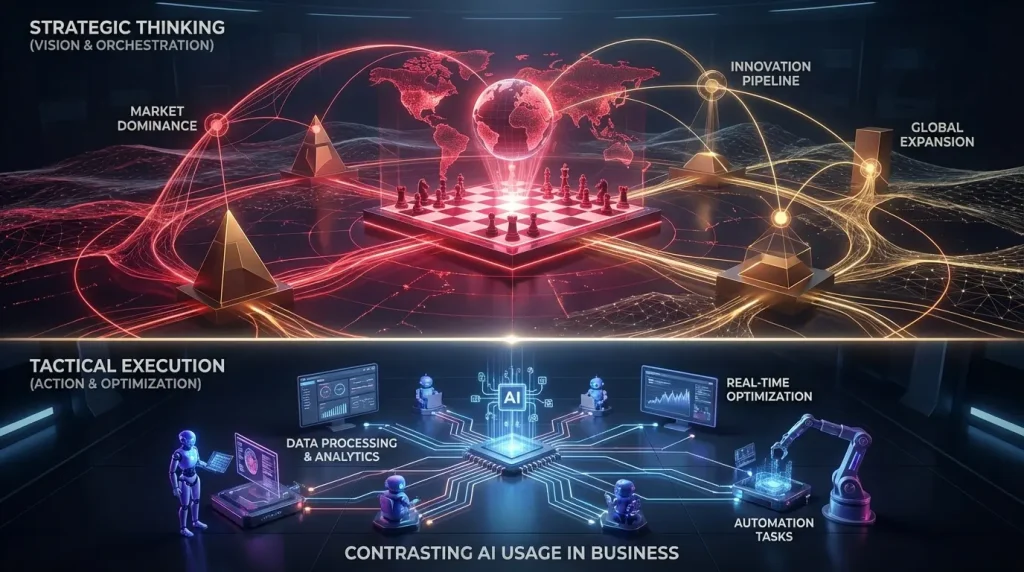
Tactical thinkers use AI to do tasks faster. Strategic thinkers use AI to do analysis they couldn’t do themselves, synthesis across domains they don’t have expertise in, and execution at scale that would require a team of 10 specialists.
The question isn’t “how do I prompt better?” The question is “what becomes possible when I can access synthetic strategic intelligence on demand?”
If you’re still thinking “AI helps me write emails faster,” you’re optimizing for monk-level efficiency while the printing press is being installed next door.
Here’s the nightmare scenario:
Your competitor isn’t using AI to create content faster. They’re using AI to:
By the time you notice they’re dominating, it’s not because they’re “better marketers.” It’s because they fundamentally changed what marketing means.
They’re not playing a faster version of your game. They’re playing a completely different game.
And you can’t catch up by working harder or hiring more people or “learning to prompt better.” You catch up by understanding that the game changed.
The printing press didn’t just make books abundant. It changed who had power.
Before: Power belonged to those who controlled knowledge (Church, monarchy, universities).
After: Power belonged to those who produced and distributed knowledge (publishers, pamphleteers, eventually the press).
AI’s doing the same thing to strategic thinking.
Before: Power belongs to those who have expertise (consultants, agencies, specialists with 20 years of experience).
After: Power belongs to those who can direct synthetic strategic intelligence (business owners who understand what questions to ask and what outcomes to optimize for).
The consultant’s monopoly is breaking. Not today. Not next quarter. But it’s happening.
And just like the printing press, those who see it coming will build empires. Those who don’t will optimize themselves into obsolescence.
Two paths:
Path 1: Keep using AI tactically. Make content faster. Optimize your existing workflows. Become the most efficient version of what you already are.
Path 2: Understand that AI is infrastructure, not a tool. Learn to think strategically – across behavioral science, economics, systems dynamics, cultural trends, competitive positioning, and data optimization – or use AI that already does.
Most people will take Path 1 because it’s easier and less threatening.
The people who take Path 2 will dominate their markets while everyone else wonders what happened.
The monks didn’t lose because they were lazy or stupid. They lost because they were optimizing for the wrong outcome in a game that was ending.
You have a choice right now that they didn’t:
You can see the paradigm shift happening. You can recognize that faster isn’t the same as different. You can decide whether you want to be the institution clinging to control or the insurgent building the new infrastructure.
AI isn’t coming for your job. It’s coming for the monopoly on who gets to do strategic work.
And the people who understand that – who build businesses where AI handles multi-domain strategic analysis while humans provide vision and direction – those people are building the printing presses.
Everyone else is perfecting their calligraphy.
I’m building something specifically for the people who recognize this shift. It’s not another AI content tool. It’s not “ChatGPT for marketing.”
It’s AI that operates as strategic infrastructure – synthesizing across behavioral science, competitive intelligence, economic modeling, systems dynamics, cultural trends, and 5 other domains simultaneously. Think of it as having a strategic team of 9 specialists working across every decision your business makes.
Because here’s what I’ve learned after 40 years of systems thinking and 20 years training marketers: The future doesn’t belong to those who do things faster. It belongs to those who do different things entirely.
If that resonates, AI Profit Engineer is where this thinking lives. Launching soon. Built for systems thinkers who recognize monopoly-breaking technology when they see it.
The printing press didn’t care if you were ready. Neither does AI.